
Emissions Gap Report
Uppdaterad: November 2023
När temperaturrekorden skenar och klimatpåverkan intensifieras, visar Emissions Gap Report 2023: Broken Record – Temperaturer når nya toppar, men världen misslyckas med att minska utsläppen (igen) att världen är på väg mot en temperaturökning på 2,5–2,9°C över pre- industriella nivåer om inte länder intensifierar sina åtgärder och levererar mer än vad de lovade i sina 2030-löften under Parisavtalet.
Förutspådda utsläpp 2030 måste minskas med minst 28-42 procent jämfört med nuvarande politiska scenarier för att komma på rätt spår för 2°C respektive 1,5°C-målen i Parisavtalet.
Att upprätthålla möjligheten att uppnå Parisavtalets mål är beroende av att stärka åtgärderna under detta decennium för att minska utsläppsklyftan. Detta kommer att underlätta mer ambitiösa mål för 2035 i nästa omgång av klimatlöften och öka chanserna att uppfylla nettonolllöften, som täcker cirka 80 procent av de globala utsläppen.
Världen uppfyller fortfarande inte Paris klimatmål, och det finns inte någon trovärdig väg till 1,5°C på plats. Endast en brådskande systemomfattande omvandling kan undvika en accelererande klimatkatastrof. Rapporten tittar på hur man kan åstadkomma denna omvandling, genom åtgärder inom elförsörjning, industri, transport och byggnadssektorer samt livsmedels- och finanssystemen.
Huvudbudskap i Emissions Gap Report 2023
Världen sätter alarmerande utsläpps- och temperaturrekord, vilket förstärker extrema väderhändelser och andra klimatpåverkan över hela världen.
- I år, fram till början av oktober, registrerades 86 dagar med temperaturer över 1,5°C över förindustriella nivåer. September var den varmaste registrerade månaden, med globala medeltemperaturer 1,8°C över förindustriella nivåer.
- De globala utsläppen av växthusgaser (GHG) ökade med 1,2 procent från 2021 till 2022 för att nå ett nytt rekord på 57,4 gigaton koldioxidekvivalenter (GtCO2e).
- På samma sätt ökade växthusgasutsläppen för G20-länderna med 1,2 procent 2022.
- Utsläppen är fortfarande ojämnt fördelade inom och mellan länder, vilket återspeglar ett globalt mönster av ojämlikhet.
Trots de accelererande klimatkatastroferna betyder otillräckliga begränsningsinsatser att världen är på väg mot en temperaturhöjning långt bortom överenskomna klimatmål under detta århundrade.
- Om begränsningsinsatserna enligt nuvarande politik fortsätter, kommer den globala uppvärmningen att begränsas till 3°C över förindustriella nivåer under hela detta århundrade.
- Att fullt ut implementera och fortsätta ansträngningar som impliceras av ovillkorliga nationellt bestämda bidrag (NDC) skulle sätta världen på rätt spår för att begränsa temperaturökningen till 2,9°C.
- Den ytterligare insatsen och fortsättningen av villkorade NDC skulle leda till att temperaturer inte överstiger 2,5 °C över förindustriella nivåer.
- I det mest optimistiska scenariot, där alla villkorade NDCs och nettonolllöften uppfylls, skulle en begränsning av temperaturökningen till 2,0°C kunna uppnås. Emellertid anses nettonolllöften för närvarande inte vara trovärdiga: inget av G20-länderna minskar utsläppen i en takt som överensstämmer med deras nettonollmål.
- I det mest optimistiska scenariot är sannolikheten för att begränsa uppvärmningen till 1,5°C endast 14 procent.
Världen måste minska utsläppen 2030 med 28 procent för att komma på en lägsta kostnadsväg för 2°C-målet i Parisavtalet och 42 procent för 1,5°C-målet.
- Ovillkorliga och villkorade NDCs för 2030 beräknas minska de globala utsläppen 2030 med endast 2 respektive 9 procent, jämfört med nuvarande policyer och förutsatt att de genomförs fullt ut.
- Nuvarande ovillkorliga NDC:er innebär att ytterligare utsläppsminskningar på 14 GtCO2e behövs 2030 över förväntade nivåer för 2°C. En minskning av 22 GtCO2e behövs för 1,5°C.
- Genomförandet av villkorade NDC:er minskar dessa uppskattningar med 3 GtCO2e.
Det har gjorts framsteg sedan Parisavtalet undertecknades, men att avsevärt öka implementeringen under detta decennium är det enda sättet att hålla fönstret öppet för att begränsa den globala uppvärmningen till 1,5°C utan betydande överskridande.
- Politiska framsteg har minskat genomförandegapet, definierat som skillnaden mellan beräknade utsläpp enligt nuvarande politik och fullständigt genomförande av NDC.
- Utsläppen av växthusgaser år 2030, baserat på gällande policy, beräknades öka med 16 procent vid tiden för antagandet av Parisavtalet. Nu är den prognostiserade ökningen 3 procent.
- Det globala genomförandegapet för 2030 uppskattas till cirka 1,5 GtCO2e för ovillkorliga NDCs (ned från 3 GtCO2e förra året), och 5 GtCO2e för villkorade NDCs (ned från 6 GtCO2e).
- Nio länder har skickat in nya eller uppdaterade NDC:er sedan COP27 2022, vilket ger det totala antalet uppdaterade NDC:er till 149.
- Om alla nya och uppdaterade ovillkorliga NDC:er är fullt implementerade, beräknas de minska växthusgasutsläppen med cirka 5,0 GtCO2e årligen till 2030, jämfört med de ursprungliga NDC:erna. De nio NDC:er som lämnats in sedan COP27 uppgår till cirka 0,1 GtCO2e av denna summa.
- Om inte utsläppsnivåerna 2030 sänks jämfört med de nivåer som impliceras av ett fullständigt genomförande av NDC:erna kommer det dock att bli omöjligt att etablera vägar som begränsar den globala uppvärmningen till 1,5°C över förindustriella nivåer, med minst en 33 procents chans under detta århundrade.
Alla nationer måste påskynda ekonomiomfattande utvecklingstransformationer med låga koldioxidutsläpp.
- Länder med större kapacitet och ansvar för utsläpp – särskilt höginkomstländer och högutsläppsländer bland G20 – kommer att behöva vidta mer ambitiösa och snabba åtgärder och ge ekonomiskt och tekniskt stöd till utvecklingsländer.
- Eftersom låg- och medelinkomstländer redan står för mer än två tredjedelar av de globala växthusgasutsläppen, möter utvecklingsbehoven med låga utsläppstillväxt.
- Kolet, oljan och gasen som utvinns från redan producerande och planerade gruvor och fält skulle släppa ut över 3,5 gånger den tillgängliga kolbudgeten för att begränsa uppvärmningen till 1,5°C, och nästan hela budgeten tillgänglig för 2°C.
Låg- och medelinkomstländer står inför ekonomiska och institutionella utmaningar i utvecklingsövergångar med låga koldioxidutsläpp men kan också ta vara på möjligheter.
- Energiomställningar i låg- och medelinkomstländer kan bidra till att ge universell tillgång till energi, lyfta miljoner ur fattigdom och expandera strategiska industrier.
- Den associerade energitillväxten kan mötas effektivt och rättvist med energi med låg koldioxidutsläpp när förnybara energikällor blir billigare, vilket säkerställer gröna jobb och renare luft.
- Internationellt finansiellt bistånd kommer att behöva skalas upp avsevärt, med nya offentliga och privata kapitalkällor omstruktureras genom finansieringsmekanismer som sänker kapitalkostnaderna. Dessa inkluderar skuldfinansiering, långfristig förmånlig finansiering, garantier och katalytisk finansiering.
- Förberedelserna av nästa omgång av NDC erbjuder möjligheten för låg- och medelinkomstländer att utveckla nationella färdplaner med inhemska visioner om ambitiösa utvecklings- och klimatpolitik och mål för vilka finans- och teknikbehov är tydligt specificerade.
- COP28 bör se till att internationellt stöd ges för utvecklingen av sådana ambitiösa färdplaner.
Den första globala inventeringen (GST) vid COP28 kommer att ge ett ramverk för att bygga nya ambitioner.
- Den första globala inventeringen enligt Parisavtalet kommer att informera nästa omgång av NDC som länder bör lämna in 2025 med mål för 2035.
- Åtgärder under detta decennium kommer att avgöra den ambition som krävs i dessa NDC, och möjligheten att uppnå de långsiktiga temperaturmålen i Parisavtalet.
- ”Globala ambitioner i nästa omgång av NDC måste bringa de globala växthusgasutsläppen 2035 till nivåer som överensstämmer med vägarna under 2°C och 1,5°C, samtidigt som man kompenserar för överskottsutsläpp tills nivåer som överensstämmer med dessa vägar uppnås.
Ytterligare försening av kraftfulla globala minskningar av växthusgasutsläppen kommer att öka framtida beroende av koldioxidavlägsnande.
- Alla vägar som är förenliga med att uppfylla Parisavtalets mål kräver omedelbara och djupa utsläppsminskningar och användning av koldioxidavlägsnande (CDR) på medellång och lång sikt.
- CDR sätts redan in, främst genom beskogning, återplantering och skogsförvaltning. Nuvarande koldioxidavlägsnande genom landbaserade metoder uppskattas till 2,0 GtCO2e årligen.
- Lägsta kostnadsvägar förutsätter betydande ökningar av både konventionella och nya CDR, men att uppnå högre nivåer av CDR är fortfarande osäkert och förknippat med risker: kring markkonkurrens, skydd av besittningsrätt och andra faktorer.
- Uppskalning av ny CDR är förknippad med olika typer av risker, inklusive att de tekniska, ekonomiska och politiska kraven för storskalig utbyggnad kanske inte realiseras i tid.
- Detta pekar på fyra viktiga områden för politiska åtgärder: fastställande och signalering av CDR-prioriteringar; utveckla robusta övervaknings-, rapporterings- och verifieringssystem för att öka trovärdigheten; utnyttja synergier och samordningsfördelar med andra insatser; och accelererande innovation.
Enligt UNEP är ”gapet” så här stort mellan vad länderna har lovat göra och vad som måste göras!
…och det förutsätter ändå att det skapas väldigt omfattande ”Negativa Utsläpp” (NET:s)
The baseline scenario estimates what would happen to global greenhouse gas emissions in the absence of any climate policies since 2005.
The current policy scenario takes into account all of the policies now in place, but assumes that no additional measures are undertaken.
The unconditional NDC scenario assumes that countries meet all of the climate pledges that have no conditions attached.
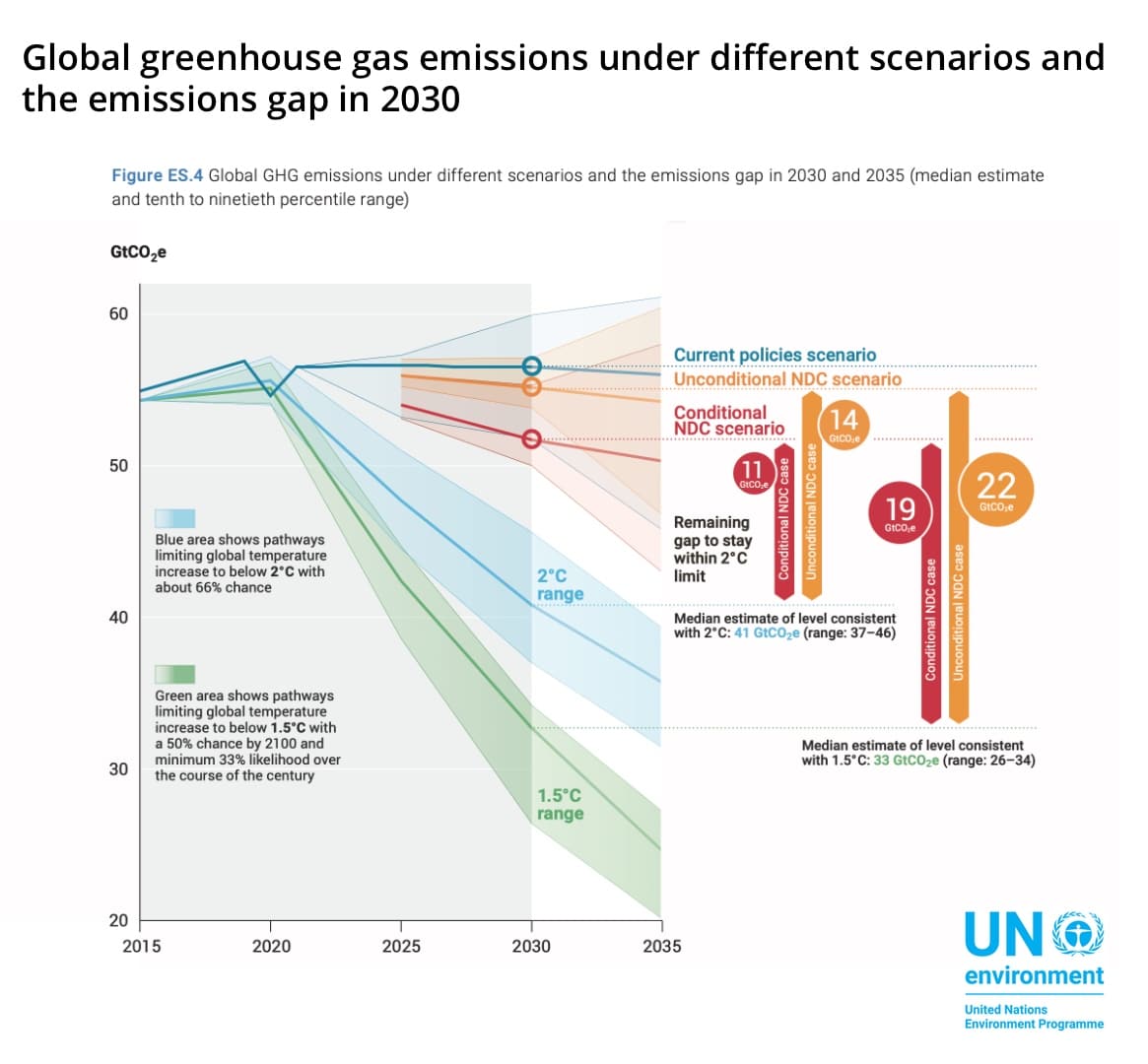
Under the conditional NDC scenario, it is assumed that countries achieve all of their climate pledges, including those with conditions.
If we want to prevent warming of 2°C by 2100, then we will have to make sure that our emissions output doesn’t exceed 41 gigatons of CO2 equivalent by 2030.
And to prevent 1.5°C of temperature rise by 2100, our total emissions will have to stay below 33 gigatons of CO2 equivalent
Rapporter
2023

2022

2021
2020
2019
2018

2017

2016

2015

2014

2013

2012

